
If you work in any organization for any period of time, you’ll experience change.
A new leader. A reorganization. A system rollout. A return-to-office policy. A benefits change.
Some changes land well and are implemented smoothly. Others feel chaotic, stressful, or surprisingly painful. I’ve always been curious about why. Why do some teams or individuals adapt quickly while others struggle? Why do well‑intentioned, well-planned initiatives sometimes fail when employee don’t buy in? And most importantly, what would it look like to design change in a way that not only supports but also focuses on the people living through it?
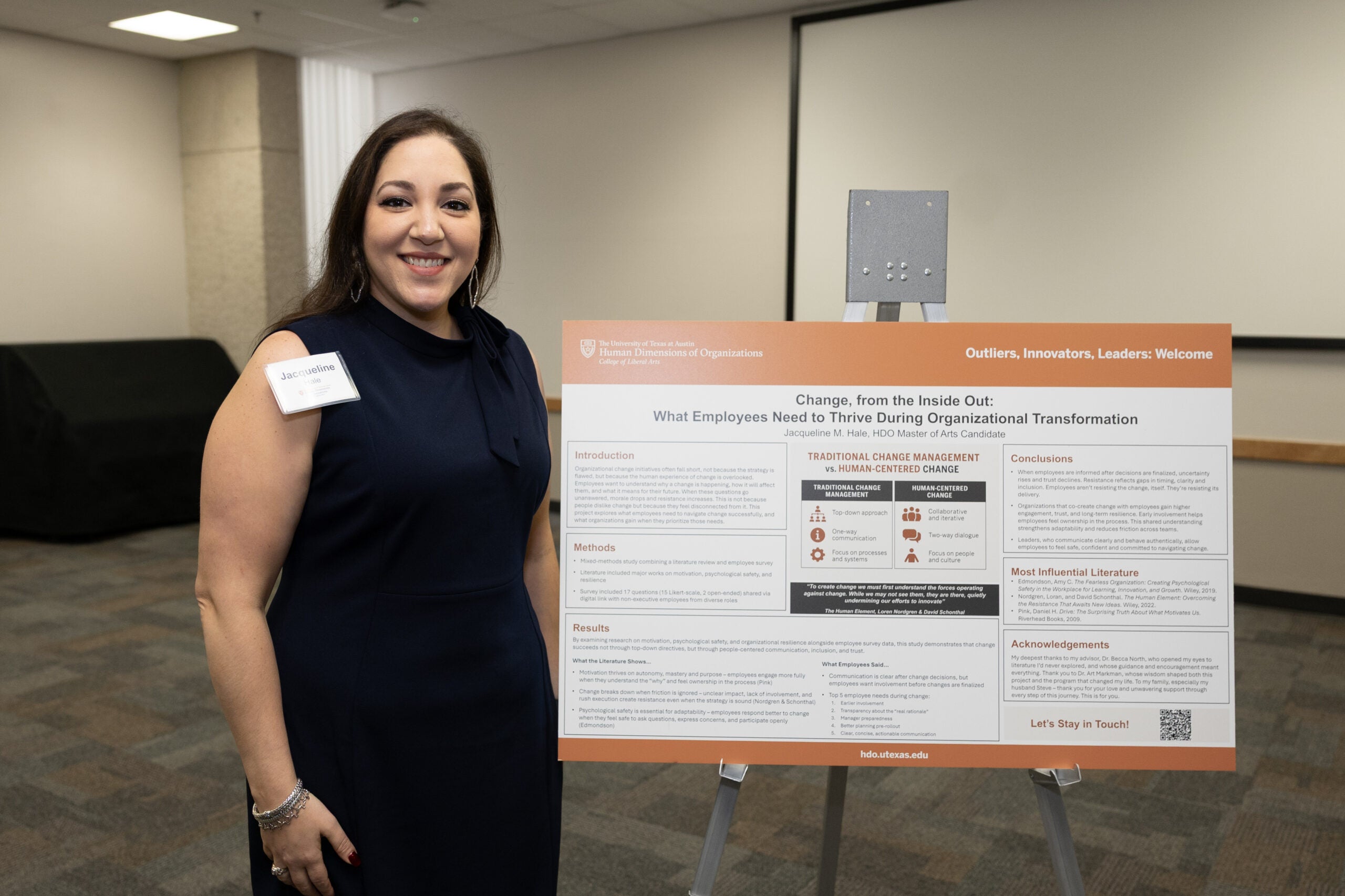
Those questions led me to my capstone topic for the Human Dimensions of Organizations (HDO) program: human‑centered change management.
Why I Chose This Topic
As an Executive Operational Planning Director, I see firsthand how frequently organizations undergo change and how they’re orchestrated from the top. Leaders often focus on the mechanics, such as timelines, structures, deliverables, and communication plans, while overlooking the human experience of the employees expected to carry that change forward.
Even when leaders have the best intentions, employees can feel blindsided or under‑informed. This results in lower morale, increased friction, and lack of engagement. Over time, I realized the problem usually wasn’t the change itself. It was how the change was delivered.
Throughout my HDO journey, my workplace implemented several association-wide change initiatives. Most notably, the transition from one CEO to another, and a restructure that impacted some departments more than others but altered ways of working for all. HDO gave me the language and frameworks to better understand what I was observing and how to best support the association through the changes. Concepts like motivation, psychological safety, and organizational culture helped me see that change isn’t just operational – it’s deeply human. So, for my capstone, I explored one core question: What do employees actually need from their leaders and organization to successfully navigate change?
How I Studied It
I leveraged two approaches to create a comprehensive view of my capstone topic: research and real‑world data.
First, I conducted a literature review across behavioral science, organizational psychology, and change management. Research consistently pointed to three drivers of successful change: intrinsic motivation, increased focus on friction over fuel, and psychological safety. Thanks to the influential works of Amy Edmondson, Loran Nordgren & David Schothal, and Dr. Art Markman.
Then, I paired those insights with an employee survey study within my organization. I took my learnings from Dr. Mary Rose’s Quantitative Research course and developed a survey with 15 Likert‑scale and two open‑ended questions about communication, leadership support, and overall experience during organizational change initiatives. The goal was simple: let the employees uncover the gaps in their change experience.
What I Found
Employees consistently reported that leadership communicates clearly once decisions are finalized. However, a clear pattern emerged in the qualitative feedback: employees wanted to be involved earlier.
They wanted to understand the real “why” behind decisions. They wanted leaders prepared to answer questions. They wanted fewer surprises, more frequent communication and more transparency.
In short, they didn’t want more information. They wanted partnership.
One insight stood out: employees aren’t resisting the change itself. They’re resisting how the change is introduced and experienced.
What This Means for Organizations
Human‑centered change isn’t simply about improving morale. It’s strategic.
When employees feel informed, trusted, and psychologically safe, they adapt more quickly, collaborate more effectively, and remain engaged through uncertainty. That leads to faster adoption, stronger performance, and greater organizational resilience.
The behaviors that make the greatest difference are simple:
• Communicate early and honestly
• Explain the true rationale behind decisions
• Equip managers with consistent tools and context
• Invite employees into the process where possible
• Treat employees like internal customers
These shifts move change from something done to employees to something co-created.
Reflecting on My HDO Capstone
Before HDO, I might have described these challenges as “communication issues” or “morale problems.” In fact, when I first entered the program, I planned to write my capstone on improving employee morale. What HDO helped me see, though, was that morale is often a symptom, not the root cause. By stepping back and examining the broader system, I realized that sweeping organizational change is one of the most powerful forces shaping how employees feel about their work.
Focusing on how employees experience change revealed something bigger: the intersection of psychology, leadership, and culture with organizational effectiveness. It helped me understand that successful transformation isn’t just about processes or plans – it’s about how people interpret, adapt to, and move through change. More importantly, it showed me how research can directly inform practice. My capstone wasn’t theoretical. It’s something I apply every day in my work.
If there’s one thing I’ve learned, it’s this: change succeeds when people do. When organizations design transformation with the human experience in mind, employees don’t just survive change. They help drive it. That’s where sustainable organizational effectiveness begins.
Looking ahead, I’m interested in continuing this work by exploring organizational resilience and how human-centered approaches can strengthen an organization’s ability to adapt through uncertainty. In a world shaped by rapid technological shifts, economic pressures, and global disruptions, resilience is not optional. I want to better understand how investing in trust, psychological safety, and employee experience doesn’t just support individuals. It equips entire organizations to navigate change more confidently and emerge stronger on the other side.
About the Author
Jacqueline Hale is an Executive Operational Planning Director who leads and supports strategic initiatives that impact her entire organization. A member of the Human Dimensions of Organizations Class of 2025, she applies a human-centered approach to organizational change, employee experience, and leadership practices that strengthen trust and resilience. She is passionate about helping organizations create meaningful, supportive work environments where employees can thrive and perform at their best.