
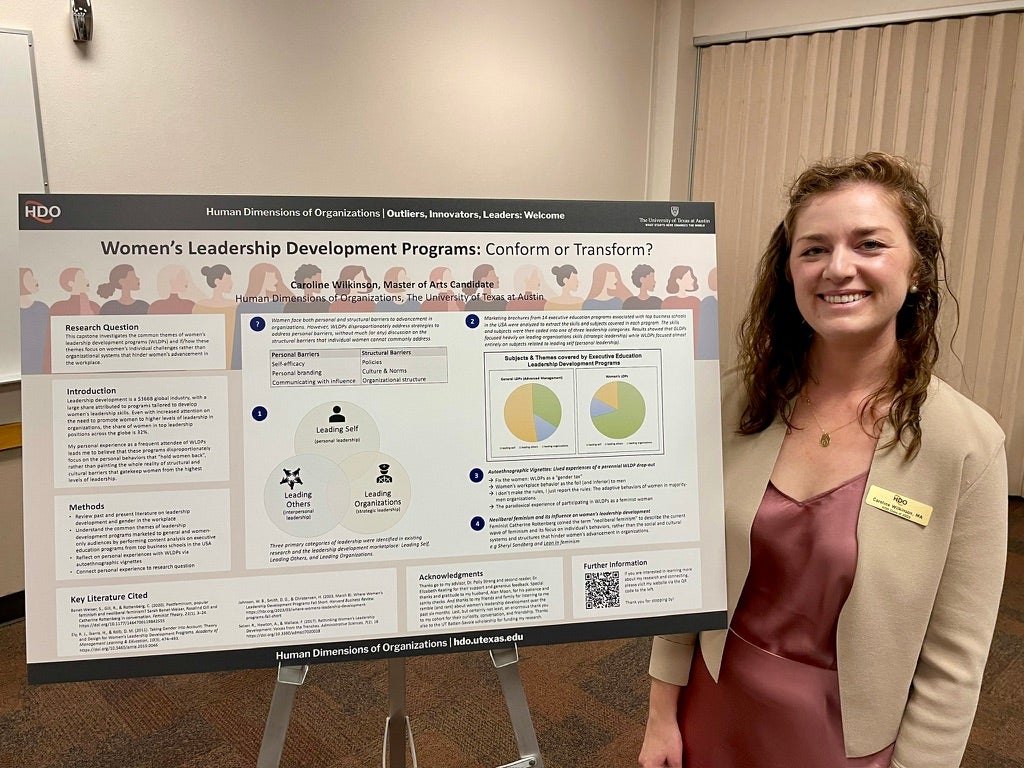
When I decided to apply to the Human Dimensions of Organizations (HDO) Master’s program at the University of Texas at Austin, I was not entirely sure what I was seeking. I had a gut feeling that work, as I had experienced it, could be better, but I lacked the language, research grounding, and framework to articulate what “better” meant, or how to get there.
HDO changed that. Over 15 months, I discovered questions I never considered before, observed the (sometimes rickety) scaffolding that upholds workplace systems, and reflected on my life and career. The curriculum sharpened my analytical skills, the exposure to research grounded my thinking, and the cohort widened my perspective. To call the experience life-changing almost cheapens its richness.
I emerged from the program a changed person with a head full of ideas and a voice to share them.
The Capstone That Became a Catalyst
I entered HDO intending to explore one of the nagging questions of my (then-current) role: how to best motivate and engage sales teams beyond the traditional commission-based compensation model. Though I find this question interesting to ponder, it did not take long for HDO to steer me in a new direction for my capstone research.
I pivoted my focus to the complex world of gender at work, choosing to study women’s leadership development programs (WLDPs). Leadership development programs are widespread and big business, with some estimating the total market size at $366 billion USD. Of this huge market, programs designed and marketed specifically to women are a significant subset and include in-house proprietary programs developed by organizations, executive education courses, workshops designed by independent consultants, and beyond. Despite the hundreds of millions of dollars spent by organizations big and small around the globe, women’s career advancement and workplace parity remains a challenge.
My deep dive into WLDPs showed that programs marketed to women focused heavily on self-leadership themes, including:
- Boosting confidence
- Strengthening personal brand
- Developing executive presence
- Overcoming imposter feelings
- Increasing Influence
- Polishing communication styles
While these topics are important for all professionals, they reinforce a subtle, but problematic message:
If women want to lead, they need to fix something about themselves.
In pouring into decades of research of gender at work and leadership development, I found a different story. Structural barriers have a greater, and more detrimental, impact on women’s advancement than perceived personal barriers.
Examples of common structural barriers found in organizations are:
- Biased hiring and promotion practices
- Lack of sponsorship
- Cultural norms
- Opaque decision-making processes
- Uneven access to stretch opportunities
- Role visibility
- Organizational expectations that conflict with caregiving realities
These are systemic issues, and no amount of role-playing exercises will dismantle these challenges and create equitable opportunity for working people.
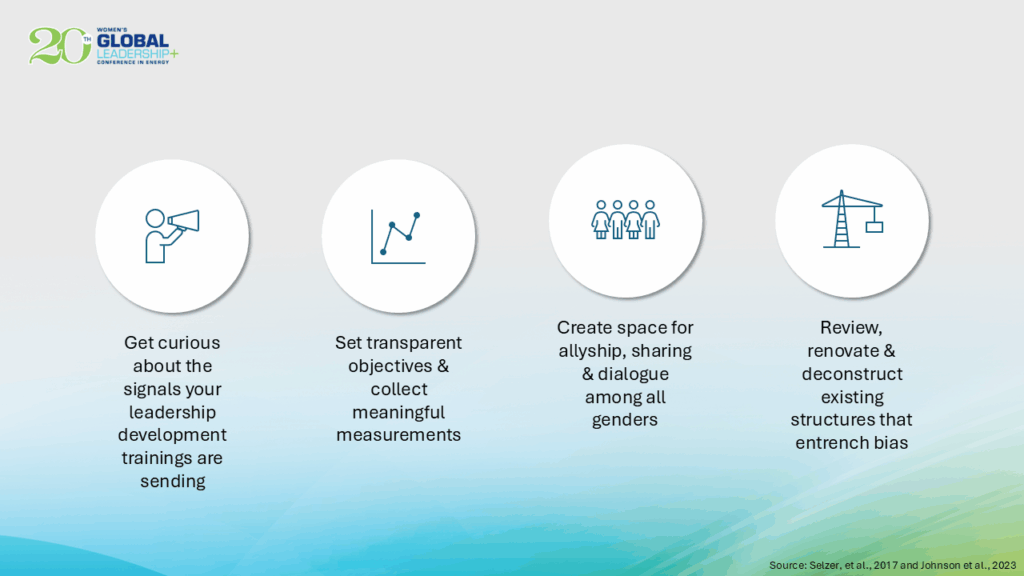
Despite this, WLDPs rarely address structural barriers. Very few programs discuss the real challenges women face, and the historic structures and systems that perpetuate those challenges.
Even more frustrating, very few programs collect long-term data on program outcomes. Organizations invest heavily in leadership development, but fail to measure if the program changes anything. Do people who attend these programs have higher promotion rates? Better retention? Higher engagement? Without data, most companies cannot answer these questions.
My capstone became an opportunity for me to reflect on my own experience with WLDPs alongside research, and opened my eyes to how we might reimagine leadership development to be more inclusive, holistic, and (most importantly) systems-aware.
2024: Finding a Global Stage
I was not ready to put my capstone away after graduation and continued to explore these topics. I wanted these ideas and findings to live beyond my laptop and research poster, and started looking for opportunities to share my work.
When I saw the call for speakers for the 2024 Women’s Global Leadership Conference in Energy (WGLC), I decided to take a shot and submit a proposal based on my capstone. The conference was a great opportunity to present my work in front of women who were navigating the structural challenges of a majority-male industry, and I was hungry for feedback from real-life practitioners, not just scholars.
To my surprise and delight, the proposal was accepted.
My talk, “Women’s Leadership Development Programs: Conform or Transform?,” presented my findings and made a case for shifting leadership development programs from focusing on individuals to shining a light on the barriers and systems that the audience navigated on a daily basis. In bringing these barriers to light, I argued, we as leaders could begin to dismantle, reimagine, and rebuild to the benefit of all.
Presenting at WGLC 2024 was the spark I needed to realize I had more to say.
2025: A Bigger Question, A Wider Frame
When it came time to submit a proposal to the 2025 WGLC, I was ready to branch out beyond my capstone and look to something more foundational.
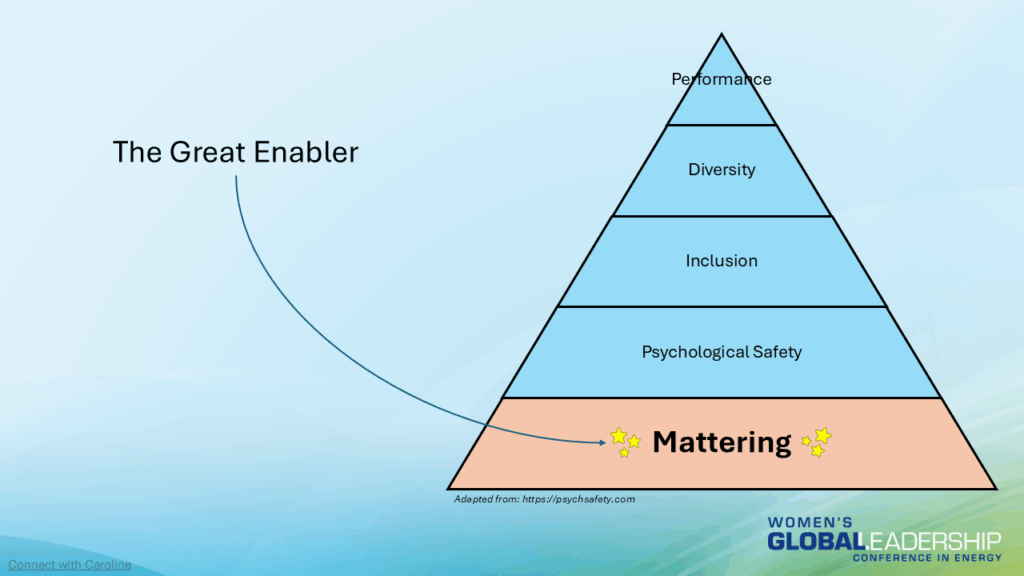
After I returned from parental leave in mid-2025, I found myself asking if my work mattered. The phenomenon and importance of mattering (the feeling of being noticed, valued, and able to make a difference) is not new, but a new book written by Zach Mercurio released in 2025 brought the topic into workplace zeitgeist overnight. As I read the book and reflected on my own experiences, I realized that believing that your work matters is not just a nice-to-have, but the foundation upon which teams build psychological safety.
Like many workplaces, psychological safety had become a bit of a buzzword in my organization. One of the very first books I read in my HDO coursework was The Fearless Organization by Amy Edmondson. The importance of psychological safety had underpinned our classroom discussions and understanding what psychological safety is, and isn’t, was foundational to our coursework across research methods, organizational culture, inclusion and belonging, and ethics.
Despite all the airtime psychological safety had received in recent years, I did not hear too many people connecting the dots between psychological safety and mattering at work.
With this observation, my 2025 WGLC talk was born.
In my session, Mattering Matters: The Foundation of Psychological Safety, I explored:
- What mattering is and why it is essential at work
- How mattering is shaped by organizational structures and norms
- The role leaders and teams play in creating environments that cultivate a sense of mattering
- How mattering lays the essential foundation for psychological safety and how psychological safety fuels performance
- And shared a worksheet to encourage participants to reflect on how they support a culture of mattering on their teams and in their workplaces
The sweet icing on the cake of my second year presenting at the WGLC was a comment from Amy Edmondson on my LinkedIn post about my talk, a real full-circle HDO moment after reading and discussing her research in class
What HDO Made Possible
Presenting at the WGLC two years in a row was a major milestone in my development as a leader, thinker, and practitioner. Before HDO, I had the confidence and presentation skills to get on stage, but I needed to develop my voice. HDO gave me the space to zoom out and gain new perspective on what work is, the role organizations play in our lives, and the interplay between people, culture, and systems.
Above all, HDO deepened my curiosity and challenged me to ask better questions, two key growth areas that serve me across all facets of life.
I am not sure what is next for me and this work, but I know I am not done dismantling existing frameworks and advocating for spaces in which people know they matter, they belong, and they can lead.
For that, I have HDO to thank.
How HDO Shapes Careers
Caroline’s journey shows how a capstone project can continue to shape a career long after graduation. What begins as a classroom assignment often becomes the foundation for meaningful work and new opportunities in the field. As we celebrate her success, we also want to recognize our current graduates who have just completed their capstones. This achievement reflects months of effort, curiosity and determination, and it deserves to be acknowledged.
Caroline Wilkinson
Caroline Wilkinson began her career with SLB in 2011 as a geophysicist and quickly gained experience across roles in operations, sales, marketing, new ventures, and project management.
In 2023 she decided to lean into her curiosity about the human side of work and pursue a master’s degree in the Human Dimensions of Organizations from the University of Texas at Austin. There she found a new passion for reimagining work and workplace culture.
At work, home, and in between, Caroline applies lessons learned in HDO as she navigates the structures and systems of modern life. Her most recent curiosity-driven venture is writing The Volunteer Lens, in which she explores and reflects on how everyday people experience “giving back” through volunteering, philanthropy, and advocacy. She pairs these reflections with her real-life work as a member of Impact Austin, a collective giving circle dedicated to strengthening Central Texas communities.
Connect with Caroline on LinkedIn or visit her Linktree to learn more.