
Entering HDO: A Shift in How I Understood Change
When I applied to the Human Dimensions of Organizations program, I did not believe I was leaving the world of organizations. At the time, my career had been rooted in working with companies, teams, and systems, and I assumed that additional education would simply sharpen my approach in that space. What I was responding to was more complicated to explain. I had begun to sense that many of the challenges I was encountering were less about strategy or structure and more about meaning, authorship, and the stories people were living inside without fully realizing it.
I joined HDO because I wanted better tools. Over time, the program changed how I understood change itself.
Early in the experience, I began to notice that what felt personal or situational often reflected something broader. HDO gave me language for patterns I had sensed but never thoroughly examined. It also helped me treat intuition as a legitimate source of data rather than something to override in favor of logic alone. That shift proved more consequential than I expected.
The Capstone and the Work of Naming Experience
The capstone process played an essential role in that transformation, though not in the way I anticipated. My research focused on what I called The Indescribable Ick, a phrase I used to describe workplace experiences that carried weight but lacked clear language. These moments were rarely dramatic or policy-violating. They were subtle, cumulative, and complex to name. Through research and narrative inquiry, I explored how the absence of language prevents people from integrating their experiences, which, in turn, shapes behavior, confidence, and decision-making over time.
While the capstone was situated within an organizational context, the questions it raised extended beyond the workplace. I became increasingly interested in how people make sense of disruption more broadly, especially when existing narratives stop working. I also noticed that my clearest insights did not arrive in isolation. They emerged through conversation, explanation, and the imperfect act of speaking something into form.
From Academic Inquiry to Application
After completing the program, I did not return to my career unchanged. I was more comfortable with uncertainty and more willing to pause before defaulting to familiar solutions. The tools I developed through HDO allowed me to navigate risk without becoming reckless and to engage ambiguity without treating it as a personal failure. That capacity mattered as my path began to evolve in ways I had not planned.
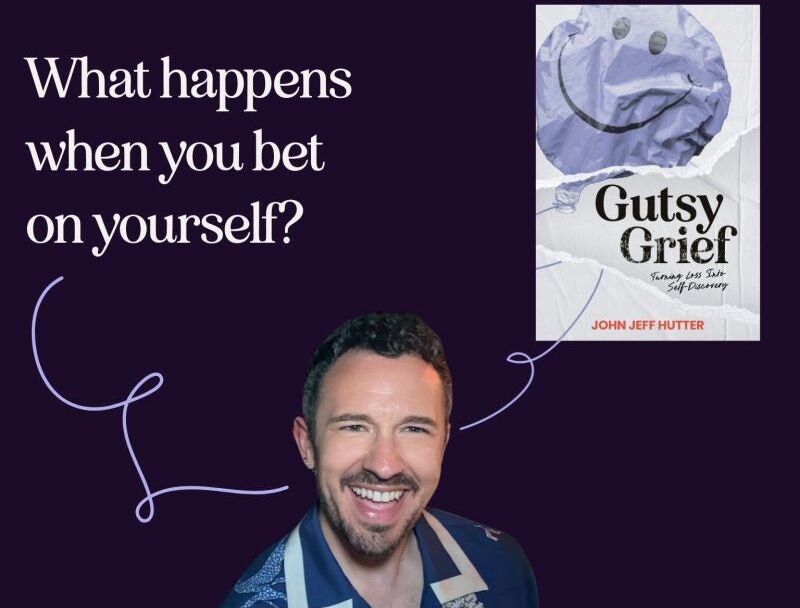
Over time, the questions I began exploring through HDO moved beyond the classroom and into my life more broadly. I found myself returning to the same themes of language, meaning, and authorship as I wrote, spoke, and worked with people navigating change. That ongoing inquiry eventually led me to write Gutsy Grief.
Although the book is rooted in loss, its scope extends well beyond grief alone. It reflects a broader framework for navigating change that is intentional, intelligent, and generative. One chapter grew directly out of my capstone research, carrying forward the central inquiry that began with The Indescribable Ick. Another chapter centers on “Think With Your Mouth,” a concept that first took shape during the capstone process and later expanded into a broader way of understanding language and conversation as tools for sensemaking and authorship.
Writing Gutsy Grief clarified something I had only started to understand while in the program. The book is not an endpoint or a personal catharsis project. It’s a practical expression of the same sensemaking discipline I first encountered through HDO, translated for a broader audience. The framework invites people to engage change without collapsing into urgency or avoidance, to stay present with disruption long enough for meaning to emerge, and to practice authorship even when certainty is unavailable. In that way, the book reflects the deeper throughline of my work today: helping people and organizations develop a more intentional relationship with change itself.
Carrying the HDO Way of Thinking Forward
What I do now spans writing, speaking, facilitation, and advisory engagements that explore how people and organizations make meaning, communicate honestly, and lead with greater intention. That work often includes supporting individuals who sense that something needs to shift but have not yet developed the confidence to act, alongside leaders who want to strengthen cultures of dialogue, treat intuition as information, and move through moments of uncertainty with discipline and care.
At the center of this effort is a commitment to restoring authorship over autopilot. Many people are living inside scripts they did not consciously choose. They appear successful by external measures while quietly disconnected from their own agency. My focus today involves helping people name experiences they already sense and offering tools to engage those insights responsibly.
This path was not the one I imagined when I entered HDO. I assumed my future efforts would remain squarely inside organizations. What I discovered instead was that changing the workplace often requires working with people outside of it as well. HDO did not pull me away from organizational life. It expanded my understanding of where meaningful change begins.
In my own experience, the value of the HDO program did not depend on staying within a traditional career trajectory. Its impact came from learning to think across disciplines, to hold complexity without rushing toward certainty, and to apply insight in contexts that were still forming. Research played an essential role in that process, not as a way to validate experience, but as a way to ground it. Engaging with empirical and objective evidence helped translate lived insight into concepts that could be examined, tested, and communicated to others. Those capacities continue to shape what I do, even as the form has changed. That same way of thinking has remained relevant in organizational settings, too, allowing ideas to move between research, language, and action without losing integrity.
The direction my work has taken represents a continuation of the thinking HDO helped cultivate. That work remains grounded, applied, and visible across the ways I write, speak, and engage with others. Much of it centers on helping people attend to what they already know but have not yet articulated, while creating space for inquiry before certainty and responsibility before reaction.
 John Jeff Hutter
John Jeff writes and speaks about how life’s hardest moments can become invitations to meet ourselves more honestly.
His work explores how storytelling, language, and curiosity shape identity, especially in the aftermath of change, loss, and trauma. He writes from the belief that living with guts is a gateway and owning the unpolished truth of our experience is how we reclaim our real humanity.
John Jeff’s approach is grounded in the study of happiness, organizational behavior, leadership, and the inventive, often surprising ways humans make meaning and learn to trust themselves again.
He holds a master’s degree in Human Dimensions of Organizations from the University of Texas at Austin (Class of 2022) with a master’s degree in Happiness Studies from the Happiness Studies Academy. Originally from Cumberland, Maryland, he now lives in Austin, Texas.