
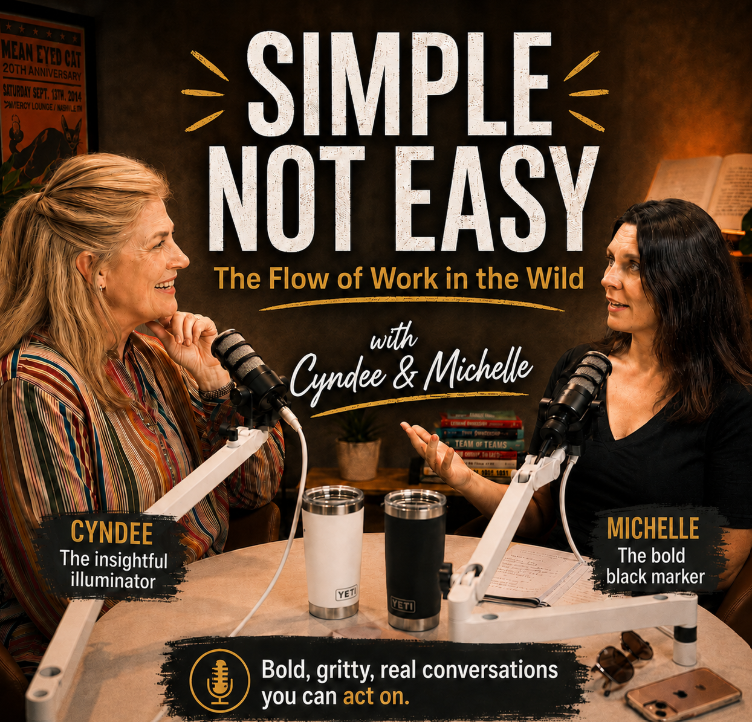
What if your next coffee break wasn’t just a complaint session, a replay of what went wrong, or another round of “can you believe this happened?”
What if it became something more useful?
A bold, gritty, real exchange you could actually act on today.
That is the spirit behind Simple, Not Easy, the podcast with Cyndee Lake and Michelle Jack. It is a space for conversations about the real flow of work: how people show up, how teams function, how decisions get made, how trust gets built or broken, and how leaders create environments where people can do meaningful work—even when the pace is relentless and the answers are not obvious.
The podcast was born from a simple observation: work is moving faster than ever, but people are not machines. In a world obsessed with artificial intelligence, automation, dashboards, metrics, and tools, we are doubling down on something just as critical—human intelligence.
Not soft. Not secondary. Not “nice to have.”
Human intelligence is the difference between a team that checks boxes and a team that actually moves. It is how we read a room, challenge a pattern, repair trust, take a risk, influence without authority, and choose whether to stay quiet or step into impact.
Enter Simple, Not Easy Podcast.
Why Start This Podcast Now?
Cyndee and Michelle started the podcast because the world of work is full of moments that look simple on the surface but are rarely easy in practice. Both graduated from the HDO program in different years but use it daily in their work in the wild. They wanted to work together on something meaningful and authentic.
Because;
It is simple to say, “Speak up.”
It is not easy to raise your hand when the room is tense, the stakes are high, and you are not sure your idea will land.
It is simple to say, “Delegate more.”
It is not easy to let go when you know you could do it faster yourself, especially when the outcome matters.
It is simple to say, “Build better relationships.”
It is not easy to slow down long enough to connect when your calendar is packed, the pressure is real, and everyone is moving in different directions.
They also know that most people do not need another theory dropped on them. They need an idea they can try. A question that shifts their perspective. A practical tool. A push. A moment of clarity that helps them choose differently the next time they are in the room.
That is why the podcast invites listeners to experiment.
Not perfect it. Not overthink it. Not wait until they feel fully ready.
Experiment.
Try one new move. Ask a better question. Notice a pattern. Change the way you enter the conversation. Decide whether you are showing up as an observer, a participant, or an impactor.
Because work is experiential. Leadership is experiential. Influence is experiential. You are effective by practicing in the wild.
Who Is This Podcast For?
Simple, Not Easy is for people who are successful—but not exactly where they want to be.
They may have the title, the track record, the credibility, or the technical expertise. They may be known as reliable, capable, high-performing, or the person everyone counts on to get things done.
And still, something is missing.
Maybe they want more influence. Maybe they are tired of carrying too much. Maybe they are frustrated that their ideas are not landing. Maybe they are leading a team but still operating like the best individual contributor in the room. Maybe they are ready for the next level but cannot quite name what is in the way.
Sometimes the shift they need is not massive. It may be one concept, one reframe, one challenge, one honest conversation, or one different point of view.
That is the audience for this podcast.
People who are tired of surface-level advice.
People who want to think more clearly, act more intentionally, and understand the human dynamics that shape the work.
As an individual, how are you showing up? Are you waiting to be invited, or are you stepping in? Are you reacting, or are you choosing? Are you protecting your comfort, or are you expanding your impact?
As a member of a team, how are you contributing to the flow of work? Are you building trust, creating clarity, challenging respectfully, and helping others succeed? Or are you sitting back, watching dysfunction unfold, and calling it “not my job”?
Within an organization, what environment is being created? Are the systems, expectations, relationships, and leadership behaviors aligned with the outcomes people say they want? Or are people being asked to behave one way while the environment rewards something else entirely?
These are the kinds of questions Simple, Not Easy brings into the open.
Why Human Intelligence Matters in Global Organizations
Michelle’s experience in global organizations gives the podcast a grounded, real-world edge. She has seen what happens when work crosses cultures, functions, geographies, time zones, personalities, and power dynamics.
In global organizations, the challenges are rarely just technical. The technical problem may be visible, but underneath it are human challenges: alignment, influence, trust, decision-making, ownership, communication, courage, and accountability.
A strategy may be clear, but the execution depends on people.
A decision may be made, but the adoption depends on people.
A process may be designed, but whether it works depends on people.
That is why the podcast does not separate business outcomes from human behavior. The two are connected.
Leaders often want performance, collaboration, innovation, speed, and accountability. But those outcomes require an environment that supports the behaviors behind them. If you want people to speak up, the environment must make speaking up useful, not punishing. If you want people to take ownership, they need curiosity, clarity, courage, and compassion.
If you want cross-functional collaboration, people need more than a meeting invite. They need shared purpose, clear decision rights, and the ability to work through friction.
This is where many organizations get stuck. They ask for new behaviors but do not examine the environment shaping the old ones.
Simple, Not Easy helps leaders and listeners slow down just enough to see what is really happening. Not to admire the problem. Not to blame. But to choose.
You can be an observer, noticing what is happening but staying on the sidelines.
You can be a participant, doing your part and staying engaged.
Or you can be an impactor, someone who intentionally shifts the conversation, the behavior, the energy, or the outcome.
It’s your choice.
Where HDO and Organizational Experience Collide
Human Dimensions of Organizations curriculum and experience collide in the wild every day.
Not in a neat classroom exercise. Not in perfectly designed unicorn models. In real conversations, real meetings, real deadlines, and real moments where risk is present.
The work of human development asks: What does this person believe? What patterns are they repeating? Where are they holding back? What are they protecting? What are they ready to practice?
The work of organizational effectiveness asks: What is the system rewarding? What expectations are clear or unclear? Where is the friction? What environment is being created? What behavior is needed for the strategy to actually work?
Together, those lenses are powerful.
Because a person can want to lead differently, but if the environment punishes candor, they may stay quiet.
A team can want to collaborate, but if goals are misaligned, collaboration becomes performative.
A leader can want empowerment, but if they keep jumping in to rescue every situation, the team never builds the muscle.
This is why Cyndee and Michelle talk about work “in the wild.” Every day brings unique challenges: people challenges, relationship challenges, persuasion challenges, energy challenges, and leadership challenges. The question is not whether those challenges will show up. They will.
The question is: what will you do when they do?
The Invitation
Simple, Not Easy is not about pretending work is simple.
It is about making work more understandable, more intentional, and more actionable, especially when it is not easy.
Cyndee, the insightful illuminator, helps listeners see what is really going on with compassion and accountability.
Michelle, the bold black marker, calls it like it is and challenges listeners to own their role in the outcome.
Together, they create a conversation that is unscripted, practical, authentic, and rooted in real experience in the wild.
So, grab your coffee. Get intentional. Listen for the idea, the tool, the question, or the push that meets you where you are.
Then try something.
Because in a world obsessed with artificial intelligence, your human intelligence may be the very thing that changes the room.
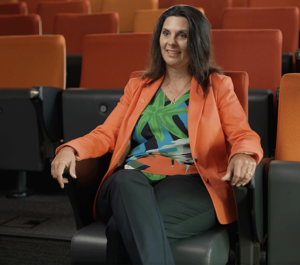 Michelle Jack is a partner with Newport LLC., a national strategic advisory firm where she helps clients with complicated business situations maximize results. Her clients have difficult situations where there are many unknowns, and few knowns. She utilizes her tools and expertise to create an environment of collaboration toward a future architected and meets the client’s needs.
Michelle graduated from the Human Dimensions of Organizations Master’s Program in 2018 and utilizes what she learned daily with her clients. Additionally, she is certified as a business behavioral coach and helps clients achieve their maximum potential. Michelle has held executive positions in both finance and operations for global companies. She believes that building relationships is key to successful partnerships and that you can architect your future by using your past and present, the knowns and unknowns.